

Share
Key Takeaways
- Human capital management payroll integrates compensation, HR, time tracking, and benefits administration into a single platform, eliminating data silos and manual re-keying between multiple systems.
- Integrating payroll into your hcm system reduces errors, accelerates pay cycles, and improves compliance with regulations like FLSA requirements and IRS rules current as of 2026.
- Organizations implementing integrated payroll typically see measurable outcomes: fewer payroll corrections, faster close cycles, and higher employee satisfaction with pay transparency and self service tools.
- Modern hcm payroll platforms are cloud-based, mobile-friendly, and analytics-driven, supporting multi-location workforces and complex compliance requirements.
- Choosing the right hcm payroll platform is a strategic decision that directly impacts retention, employee engagement, and overall business growth.
Introduction to Human Capital Management Payroll
Payroll seems straightforward. Pay employees on time. File the right taxes. Stay compliant.
But for many organizations, payroll quickly becomes one of the most complex parts of running a business. Tax rules change. Compliance requirements multiply. Employee questions pile up.
Human capital management payroll represents a fundamental shift in how organizations handle compensation. Instead of running payroll in a standalone tool, hcm payroll connects hiring, time tracking, benefits, and compensation in a single source of truth. The entire employee lifecycle—from pre hire through retirement—flows through one integrated platform.
As of 2026, many mid-sized and large organizations are moving to cloud hcm payroll platforms. The reasons are practical: hybrid work arrangements, multiple locations, and increasingly complex tax regulations require systems that talk to each other automatically.
This article covers what human capital management payroll is, how payroll fits into broader hcm strategy, key benefits of integration, features to look for in hcm software, guidance on choosing and implementing the right system, and current trends shaping the future of workforce pay. The goal is to help hr leaders, payroll teams, and finance leaders make informed decisions about their payroll infrastructure.

What Is Human Capital Management (HCM) Payroll?
Human capital management is the strategy and technology organizations use to recruit, manage, develop, and retain their workforce. It covers talent acquisition, onboarding, performance management, learning, succession planning, and compensation.
Human capital management payroll is the component within that platform that handles compensation, taxes, and benefits. It’s not a separate tool bolted onto HR. It’s embedded directly within the human capital management software.
Here’s the practical difference. Traditional payroll software calculates pay and taxes. That’s it. Someone has to manually import data from HR systems, time tracking tools, and benefits platforms. Every import creates opportunity for errors.
Human capital management hcm payroll pulls real-time data automatically. When someone gets hired, their employee data flows directly from onboarding into payroll configuration. When they clock in, time tracking data feeds straight into pay calculations. When they elect benefits, deductions update automatically.
Modern hcm payroll platforms are typically delivered as cloud software on a subscription model. Regulatory updates—tax table changes, new labor law requirements—are built into the platform. Your team doesn’t need to manually research and implement every change.
The scope is comprehensive. Hcm payroll covers:
- Onboarding data capture and employee record creation
- Earnings and deductions configuration
- Tax withholding calculations (federal, state, local)
- Benefits premiums and deductions
- Direct deposit processing
- Year-end forms (W-2s, 1099s in the U.S.)
- Payroll reporting and analytics
Consider a simple scenario. A new employee starts on March 15. In a traditional setup, HR completes onboarding paperwork, then sends information to payroll. Someone re-keys the data. They hope nothing gets lost in translation.
With hcm payroll, onboarding completion automatically flows the new hire into the next payroll cycle. No re-keying. No waiting for manual handoffs. The employee gets paid correctly on their first check.
This integration eliminates the gaps where errors traditionally hide.
How Payroll Fits into the Wider HCM Strategy
Payroll is not a back-office task that happens in isolation. It’s a core part of the employee experience and overall human capital strategy.
Think about it from an employee’s perspective. Getting paid accurately and on time affects how they feel about their employer. Pay problems erode trust quickly. Pay transparency and easy access to payroll information build confidence.
Human capital management hcm platforms treat payroll as part of the entire employee lifecycle. The payroll system uses shared workforce data with other hr processes:
Recruiting and talent acquisition: Offer letters include compensation data that flows directly into payroll configuration once the candidate accepts.
Onboarding: New hire information—tax elections, direct deposit, benefit choices—populates payroll automatically.
Performance management: Merit increases, promotions, and bonuses connect to compensation changes in payroll.
Learning and career development: Certifications or skill achievements that trigger pay differentials update automatically.
Succession planning: Workforce planning models include compensation costs from payroll data.
Accurate and timely pay directly underpins engagement and retention. When employees trust that their paycheck will be correct, when they can access their pay information through employee self service portals, they spend less mental energy worrying about compensation mechanics.
This makes payroll a strategic lever, not just an operational necessity.
Integrated payroll also supports compensation strategy at a broader level. Pay bands, merit increase budgets, bonus programs, and variable pay structures can be managed consistently across the hcm suite. Hr teams and finance leaders see the same data. They make decisions from shared information.
The connection to workforce management extends to planning and budgeting. Payroll data feeds headcount costs, overtime trends, and labor forecasting. When hr leaders and finance collaborate on workforce plans, they’re working from actual labor costs, not estimates.
Benefits of Integrating Payroll with Your HCM System
Integration removes data silos and manual work. When your payroll system operates as part of your broader human capital management platform, the benefits compound across multiple areas.
Operational Efficiency
Eliminating duplicate data entry between hr systems and payroll reduces cycle time significantly. During peak periods—like year-end processing—this efficiency gain becomes especially pronounced.
When changes like promotions, location transfers, or benefit elections happen once in a central system, payroll calculations update automatically. No one needs to manually coordinate across platforms. No one needs to reconcile differences between what HR shows and what payroll shows.
Organizations implementing integrated hcm payroll typically report faster payroll closing cycles—reductions of 20-40% are common. Payroll teams benefit from a unified, real-time payroll dashboard and spend less time chasing down information and more time on analysis and exception handling.
Data Accuracy
When one employee record drives HR, time tracking, and payroll, consistency is built in. A promotion entered in HR updates the employee’s pay rate in payroll. A benefits election change updates deduction calculations automatically.
This single source of truth eliminates the reconciliation problems that plague organizations running multiple systems. Historical correction rates in fragmented systems can consume weeks of administrative effort. Integrated systems reduce this substantially.
Data accuracy matters beyond operational convenience. Accurate workforce data is the foundation for compliance, reporting, and strategic decision making.
Compliance
Integrated systems apply pay rules, overtime calculations, and tax rates consistently across locations. This is increasingly important given the complexity of current tax regulations.
As of 2026, federal tax withholding has been recalculated through IRS Publication 15-T, reflecting changes from the One Big Beautiful Bill Act. The Social Security wage base for 2026 is $184,500 with a 6.2% rate. The affordability threshold under the Affordable Care Act jumped to 9.96%—the highest since the ACA launched.
Modern hcm payroll platforms include automatic updates for these changes. Your payroll teams don’t need to manually research every regulatory shift. The system handles it.
Integrated platforms also store audit-ready histories. When labor audits, tax inquiries, or internal compliance reviews happen, standardized reports are available immediately.
Cost Savings
Fewer payroll corrections mean less rework, less employee communication about errors, and fewer potential penalties. Reduced reliance on manual spreadsheets and workarounds frees up staff time.
The compliance risk reduction has direct financial impact. Fines for miscalculated overtime or incorrect tax withholding can be substantial. Avoiding those penalties translates into measurable savings.
Organizations also see reduced help-desk volume. When employees can access pay information through self service tools, they don’t need to contact HR with basic questions.
Employee Experience
Modern hcm payroll platforms provide employees with self-service access to pay slips, tax forms, and time-off balances through mobile applications.
This accessibility addresses a core expectation. Employees expect to see their pay information on their phone. They expect to download tax forms without submitting a request. They expect transparency.
Financial flexibility is becoming a retention tool. These programs work best when payroll is integrated with time tracking and HR, ensuring accurate calculations of earned amounts.
Strategic Insights
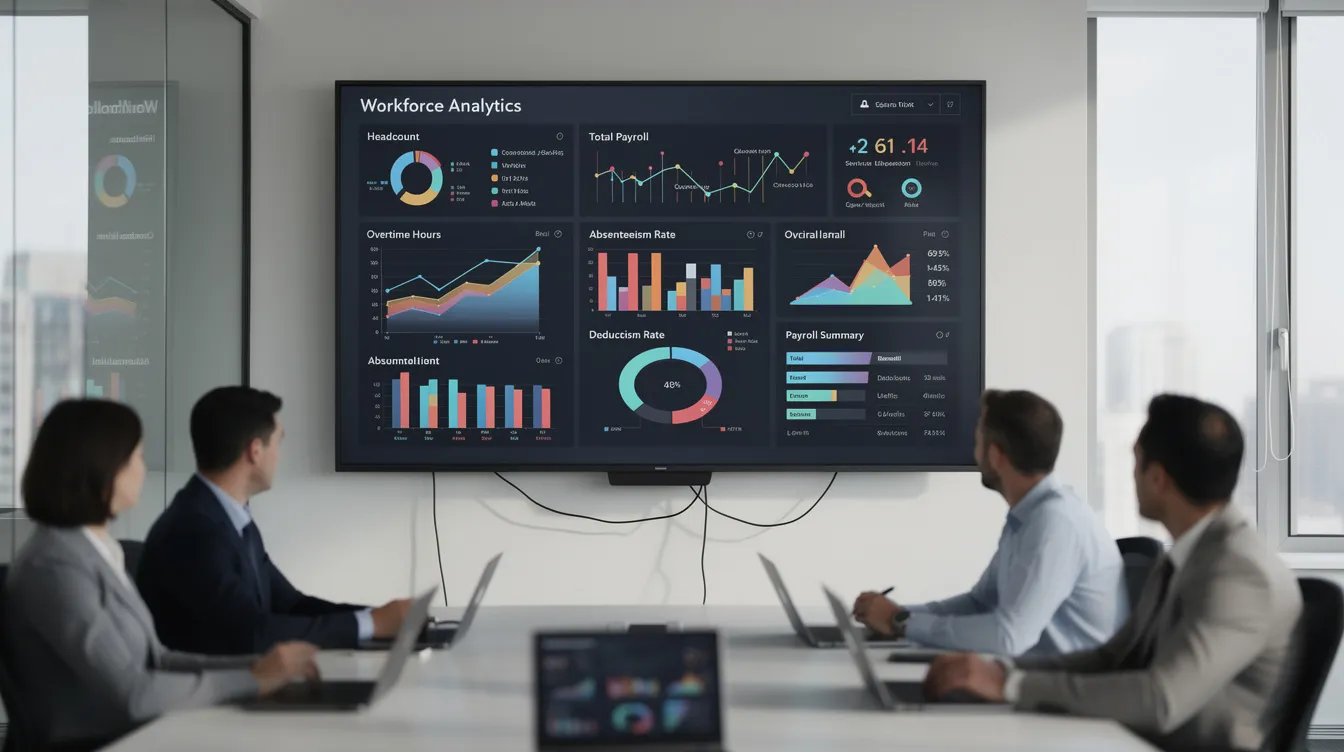
Integrated hcm payroll generates analytics capabilities that support data driven decisions. Labor cost analysis by department, overtime trends relative to absenteeism, pay equity indicators, and accurate paycheck and 401(k) estimations for headcount cost forecasting—these insights become accessible through dashboard reporting.
Hr teams and finance leaders can use this detailed analytics to inform budgeting decisions, identify workforce optimization opportunities, and develop compensation strategy based on actual data rather than estimates.
Key Features to Look for in HCM Payroll Software
Not all human capital management software offers the same depth in payroll. Buyers need to evaluate features against their workforce complexity and business needs.
Core Payroll Capabilities
The payroll module should support the fundamental requirements your organization needs to pay employees accurately, including essential integrated payroll software features:
Multi-cycle payroll runs: Different employee groups may need different pay schedules. Hourly staff might be paid weekly while salaried employees are paid semi-monthly.
Support for hourly and salaried staff: Different pay types require different calculation logic. The system should handle both seamlessly.
Time tracking integration: Payroll should pull directly from time clocks, mobile time entry, or timesheet systems without manual imports.
Automated tax calculations: Federal, state, and local tax withholding should calculate automatically based on employee location and elections.
Flexible earnings and deductions: Your organization likely has unique pay codes, bonuses, stipends, and deductions. The system should accommodate configuration without custom development.
Compliance and Regulatory Support
Payroll compliance protects your business from tax penalties, wage disputes, and regulatory audits. A strong understanding of payroll taxes, payments, and penalties is essential, and the payroll capabilities should include:
Current tax tables: The system should update tax tables automatically when rates change, including the 2026 IRS Publication 15-T changes.
Garnishment handling: Court-ordered deductions need proper calculation and prioritization according to legal requirements.
Labor law rules: Overtime thresholds, minimum wage by jurisdiction, and break time rules should be built in.
Jurisdiction-specific requirements: States like Oregon now require written breakdowns of pay and deductions for new hires. Washington’s Paid Family & Medical Leave rules changed significantly. The system should handle local regulations without manual workarounds.
Integration Depth
The payroll module should share real-time data with other components of your hr workflows:
HR core: Employee records, job information, compensation history should flow bidirectionally.
Time and attendance: Hours worked, overtime, paid time off should feed directly into payroll calculations.
Benefits administration: Benefit elections should automatically update payroll deductions.
Performance management: Merit increases and bonuses from performance processes should connect to compensation changes.
Accounting/ERP: Payroll journal entries should export to your financial systems in the required format.
Analytics and Reporting
Standard payroll reports cover the basics. But modern hcm solutions should offer more:
Custom report builders: Create reports specific to your business objectives without IT involvement.
Executive dashboards: High-level views of labor costs, headcount trends, and compliance metrics.
Export formats: Finance teams and external auditors need data in specific formats. The system should accommodate common export requirements.
Usability
Technology only delivers value if people actually use it effectively:
Intuitive workflows: Routine tasks like running payroll, adding a new employee, or processing a termination should be straightforward.
Role-based access: Payroll specialists, hr teams, managers, and employees should each see appropriate information. Data security depends on proper access controls.
Mobile design: Responsive design for tablets and phones is essential. Employees expect to access pay information from their devices.
Scalability and Global Needs
If your organization operates across multiple states, legal entities, or countries, consider broader payroll management requirements such as:
Multi-entity support: Different legal entities may have different payroll requirements. The system should handle consolidated reporting while maintaining entity-specific configuration.
Multi-state compliance: Tax rates, labor laws, and reporting requirements vary by state. The system should handle this complexity automatically.
Multi-currency and country-specific rules: Organizations expanding internationally need platforms that support global payroll or integrate with in-country providers.
Choosing the Right HCM Payroll Solution
Software selection should be treated as a structured business project grounded in sound human resource payroll management principles. This isn’t just an IT decision or an HR decision. It affects payroll teams, finance, operations, and employees.
Build Your Evaluation Team
Involve representatives from:
- HR (employee data, compliance, onboarding)
- Payroll (current pain points, processing requirements)
- Finance (reporting, accounting integration, budget)
- IT (security, integrations, technical requirements)
- Leadership (strategic priorities, timeline, investment approval)
Document Current State and Desired Outcomes
Before evaluating vendors or switching payroll providers, understand where you are and where you want to go:
Current pain points: Are payroll closes delayed? Is the correction rate high? Are employees frequently asking basic pay questions? Are compliance audits difficult?
Desired outcomes: Faster payroll cycles? Fewer corrections? Better employee self-service? Improved analytics? Multi-location support?
Must-have features: Based on your workforce complexity, what capabilities are non-negotiable?
Assess Vendors Systematically
Not every platform is the right system for every organization. Evaluate vendors on:
Industry fit: Does the vendor have experience with organizations like yours? Manufacturing, healthcare, retail, and professional services have different requirements.
Implementation track record: How long do implementations typically take? What’s the vendor’s success rate?
Customer references: Talk to current customers with similar workforce size and complexity. Ask about their implementation experience and ongoing support quality.
Ongoing support: What are the service-level agreements? When is support available? How are critical issues handled?
Align Budget with Expected ROI
HCM payroll platforms typically use subscription pricing. Compare:
- Subscription fees (monthly or annual)
- Implementation costs (configuration, data migration, training)
- Ongoing costs (support, additional modules, user licenses)
Balance these costs against projected savings:
- Reduced payroll corrections
- Faster close cycles (staff time savings)
- Lower compliance risk (penalty avoidance)
- Reduced help-desk volume
Set Realistic Timelines
For a mid-sized organization starting planning in early 2026, realistic go-live expectations range from a few months to six months depending on scope.
Projects with extensive historical data migration, complex union rules, or multi-country coverage need more time. Rushing implementation creates problems that take longer to fix than doing it right initially.
Run Demos and Pilot Programs
Generic feature lists don’t reveal how software actually works. Have stakeholders test real workflows:
- Onboard a new employee
- Enter time for hourly workers
- Process a payroll cycle
- Run a compliance report
- Access pay information as an employee
Hands-on evaluation reveals usability issues and capability gaps that demonstrations and slide decks miss.
Implementing an HCM Payroll System Successfully
Successful implementation is as much about change management and data quality as it is about technology. Organizations that treat implementation purely as a technical project often struggle.
Create a Detailed Project Plan
Structure implementation in phases:
Discovery: Document requirements, map current processes, identify integration points, establish project governance.
Data cleansing and migration: Prepare existing data for migration (more on this below).
Configuration: Set up the system according to your specific requirements—pay codes, tax jurisdictions, approval workflows, reporting.
Parallel testing: Run payroll in both old and new systems to compare results.
Go-live: Switch to the new system for actual payroll processing.
Post-launch review: Monitor metrics, address issues, optimize processes.
Prepare Your Data
Data quality determines implementation success. Before migration:
Clean up employee records: Remove duplicates, correct inconsistencies, verify current information.
Standardize pay codes: Ensure consistent coding schemes that translate cleanly to the new system.
Validate historical data: Decide what historical payroll data to migrate and verify its accuracy.
Document exceptions: Identify unusual situations (special pay arrangements, unique deductions) that need specific handling.
Organizations underestimating data preparation frequently encounter delays and post-go-live issues.
Run Parallel Payroll
Process payroll in both the old and new systems simultaneously for at least one or two pay periods. Compare results carefully.
This parallel period should be long enough to capture various pay scenarios:
- Regular pay periods
- Overtime situations
- Bonus processing
- Benefits deduction changes
- New hires and terminations
Identify and resolve discrepancies before fully switching to the new system.

Train Your People
Different roles need different training:
Payroll specialists: System workflows, configuration, troubleshooting, exception handling.
HR staff: How changes they make in recruiting or onboarding flow into payroll.
Managers: Interpreting payroll reports, approving time, responding to employee questions.
Employees: Accessing self-service features, understanding changes to pay processes.
Role-specific training works better than generic system overviews.
Communicate Changes Clearly
Employees need to know what’s changing and when. Clear communications—distributed well in advance of go-live—reduce confusion and support volume.
Cover:
- What’s changing in how they access pay information
- New self-service capabilities
- Timeline for the switch
- Who to contact with questions
Establish Governance and Controls
From day one, define:
User roles: Who can access what information, who can make changes, who can approve transactions.
Approval workflows: What changes require approval and from whom.
Audit trails: The system should log who made what changes and when.
These controls maintain data security and compliance from launch.
Measure Success After Go-Live
Establish baseline metrics before launch:
- Payroll error rate
- Time to close payroll cycles
- Volume of employee inquiries about pay
- Employee satisfaction with pay transparency
Measure these same metrics over the first 3-6 months. Typical improvement targets include:
- Reducing payroll cycle time by 20-40%
- Decreasing correction rates by 50% or more
- Improving employee satisfaction with pay information accessibility
These metrics provide objective evidence of whether the investment is delivering expected benefits.
HCM Payroll Trends and the Future of Workforce Pay
By 2026, hcm payroll is increasingly shaped by automation, analytics capabilities, and adaptation to new work patterns. The modern workforce expects different things from payroll than workers did a decade ago.
Automation and AI
Rule-based automation handles routine tasks without human intervention. Artificial intelligence and machine learning extend this further by flagging anomalies—unusual overtime patterns, unexpected tax calculations, potential compliance issues—before payroll finalization.
Rather than reviewing every paycheck manually, payroll teams focus on exceptions identified by the system. Ai driven insights help identify patterns that humans might miss across large datasets.
This shift changes the role of payroll professionals. Less time on data entry and calculation verification. More time on analysis, compliance, and strategic support.
Pay Flexibility
Employee expectations around pay are evolving.
Modern hcm payroll platforms can support these options while maintaining compliance. The key is integration with time tracking so earned amounts calculate accurately.
Other financial wellness benefits—transparent retirement plan information, flexible daily pay options, and on-demand access to pay documents—are positioned as low-friction retention mechanisms.
Cloud-Based, Mobile-First Experiences
Employees expect to see pay information on their phone. They expect to update tax withholding forms without visiting HR. They expect to request time off and see the impact on their next paycheck.
Cloud hcm platforms deliver these experiences through mobile applications and responsive web design. The expectation isn’t new anymore—it’s table stakes.
Data Privacy and Security
Payroll data is among the most sensitive information an organization holds. Non-negotiable requirements for future-ready systems include:
Encryption: Data encrypted in transit and at rest.
Role-based access: Employees see their own information. Managers see their team’s information. Payroll specialists see what they need to process payroll. No one sees more than necessary.
Compliance with data protection regulations: GDPR, CCPA, and other regulations require specific handling of personal data.
Preparing for Regulatory Change
Globally, more than 75% of tax authorities are expected to enforce real-time or near-real-time payroll reporting by 2026. Error detection becomes immediate rather than delayed until year-end reconciliation.
Organizations that modernize their hcm payroll infrastructure by 2026 position themselves to handle these regulatory changes. Those still running fragmented systems face increasing compliance risk as enforcement becomes more immediate.
The trajectory is clear. Integration, automation, and real-time data are becoming baseline expectations rather than competitive advantages.
Frequently Asked Questions about HCM Payroll
Is there a difference between traditional payroll software and HCM payroll?
Traditional payroll software focuses narrowly on calculating wages and taxes. These tools do one thing—process payroll—and they do it in isolation. To get employee data, someone imports it from the HR system. To get hours worked, someone imports it from time tracking. Every import is manual. Every import creates opportunity for errors.
Hcm payroll is embedded in a broader human capital management platform. It automatically pulls data from recruiting, onboarding, time tracking, and benefits administration for a single, consistent view of each employee. When someone gets hired, their information flows to payroll. When they clock in, hours flow to payroll. No imports. No re-keying.
This integration reduces manual work, lowers error rates, and supports richer analytics about labor costs and workforce trends.
Does HCM always include payroll, or can payroll be added later?
Many unified hcm suites offer payroll as a core module included from the start. Others treat payroll as an optional component that can be implemented after core hr is live.
If your organization plans to modernize payroll within 12-24 months, choose an hcm solution that either has native payroll capabilities or proven, deeply integrated payroll partners.
Staggering implementation—core hr first, payroll second—can make change management easier. But this approach works best when data models and processes are designed with payroll in mind from the start. Retrofitting payroll integration onto a system that wasn’t built for it creates problems.
How does integrated HCM payroll improve compliance?
Having all employee and time data in one place helps apply correct pay rules, tax rates, and overtime calculations consistently across locations.
Hcm payroll systems typically include automatic updates for tax tables and regulatory changes. When the IRS updates Publication 15-T or a state changes its minimum wage, the system updates. Your payroll teams don’t need to manually track every change.
Built-in audit trails and standardized reports make it easier to respond to labor audits, tax inquiries, or internal compliance reviews. You’re not scrambling to reconstruct history from multiple systems.
What size company benefits most from HCM payroll?
Organizations of many sizes benefit from integration. But the impact is especially strong for employers with 100 or more employees, multiple locations, or complex pay rules.
Complexity matters more than headcount alone. A 75-person company with three locations, multiple pay schedules, and various benefit plans may need integrated hcm payroll more than a 200-person company at a single location with straightforward compensation.
Smaller businesses often start with simpler payroll platforms and move to hcm payroll as they grow, add locations, or expand benefits and variable pay programs. The right time to switch is when the administrative burdens of disconnected systems start creating real problems.
How long does it typically take to implement an HCM payroll system?
For a mid-sized organization, implementation typically ranges from a few months to around six months. The variables that affect timeline include:
- Data quality (cleaner data = faster migration)
- Number of locations and jurisdictions
- Complexity of pay rules and configurations
- Integration requirements with other systems
- Availability of project resources
Projects with extensive historical data migration, complex union rules, or multi-country coverage need more time for configuration and testing.
Careful planning, early stakeholder involvement, and thorough parallel testing are more important than compressing the timeline. Rushed implementations create problems that take longer to fix than doing it right.

Additional Frequently Asked Questions
How does HCM payroll handle employees who work in multiple states?
Multi-state employment is increasingly common with remote work arrangements. Hcm payroll platforms track employee work locations and apply appropriate tax withholding for each jurisdiction. When an employee works from different states during a pay period, the system calculates taxes based on where work was performed.
This requires accurate time tracking data that includes location information. It also requires the system to maintain current tax rates and rules for all applicable jurisdictions. Without this capability, multi-state compliance becomes a manual nightmare.
Can HCM payroll support predictive analytics for workforce planning?
Many modern hcm platforms include predictive analytics capabilities that use historical payroll and workforce data to forecast future trends. These tools can project labor costs based on planned hiring, model the impact of proposed compensation changes, and identify patterns in turnover or overtime that might indicate emerging issues.
The quality of predictive analytics depends on data quality and history. Organizations that have maintained clean, integrated data over time get more accurate forecasts than those migrating from fragmented systems with inconsistent historical records.
What happens to payroll data when an employee leaves the organization?
Employee records aren’t deleted when someone leaves. Payroll history must be retained for tax reporting, potential audits, and rehire scenarios. Hcm payroll platforms maintain terminated employee records in accordance with retention requirements—typically several years depending on the type of record and applicable regulations.
Access to terminated employee records is typically restricted to authorized users. The records remain available for historical reporting, W-2 corrections, and compliance inquiries without cluttering active employee views.
How do HCM payroll systems handle payroll for particular purpose or specialized employee classifications?
Different employee types—full-time, part-time, seasonal, contractors, interns—often have different payroll requirements. Hcm payroll systems use employee classification to apply appropriate rules: different benefit eligibility, different overtime calculations, different tax treatment.
The system should be configurable to handle your organization’s specific employee classifications without requiring workarounds. During implementation, document all employee types and their particular requirements to ensure proper configuration.
What role do enhanced productivity tools play in modern HCM payroll?
Beyond core payroll processing, modern hcm payroll platforms include tools designed to boost productivity and enhance productivity for both payroll staff and employees, such as online payroll systems with automated tax and payment options. Workflow automation handles routine tasks without manual intervention. Simplified processes reduce the steps required to complete common activities. Self-service capabilities let employees handle basic requests without hr involvement.
These tools free up payroll staff to focus on exceptions and strategic work rather than routine tasks. The result is the ability to save time across the organization while maintaining payroll accuracy.
Related events

Zero-Cost Benefits: How Earned Wage Access Reduces Turnover

Key HR Metrics Every Manager Should Track

Exit Interview Best Practices for High-Turnover Industries